
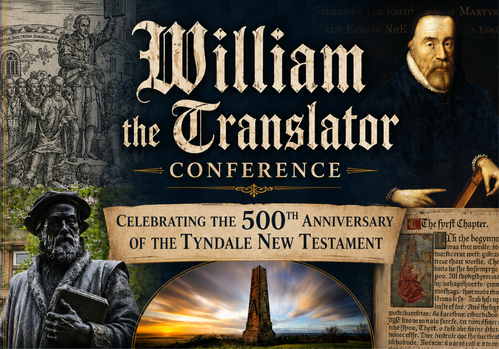
Tyndale Conference Intro
Oct 16, 2026 • David Reid
1) Assessing the Pre-Tyndale Historical Context (900-1500) | Bryan Ross
Oct 16, 2026 • Bryan Ross
2) The Life & Times of William Tyndale (1494-1524) | Alex Bojko
Oct 16, 2026 • Alex Bojko
3) The Cologne Fragment: The Thwarted First Attempt (1525) | David Reid
Oct 17, 2026 • David Reid
4) The 1526 Worms New Testament: Assessing the First Printed English Bible | Bryan Ross
Oct 17, 2026 • Bryan Ross
5) The 1530 Pentateuch & Other OT Translations: Giving the Hebrew an English Voice | Alex Bojko
Oct 17, 2026 • Alex Bojko
6) The Use & Misuse of Tyndale's Famous Ploughboy Statement | David Reid
Oct 17, 2026 • David Reid
7) Tyndale the Terrific Translator: Assessing Translational Choices & Use of English | Bryan Ross
Oct 17, 2026 • Bryan Ross
8) Prologues, Prefaces, Protestantism: Tyndale's Theological Beliefs | Alex Bojko
Oct 18, 2026 • Alex Bojko
9) Rough Draft: Assessing Tyndale's Work as a Rough Draft of the KJB | Bryan Ross
Oct 18, 2026 • Bryan Ross
10) Arrest, Execution, & Legacy: Assessing Tyndale's Impact on the English Language | David Reid
Oct 18, 2026 • David Reid
Tyndale Conference Closing
Bryan Ross, David Reid
View More
William the Translator: 10 Lessons
Explore each lesson's recording and transcript-matched video topics.
Lesson 1Doc pp. 1-20 (PDF pp. 5-24) Assessing the Pre-Tyndale Historical Context (900-1500)By Bryan C. Ross Traces how English rose from a scorned 'barbarous tongue' after 1066 to a vibrant national language, alongside early vernacular Scriptures (Caedmon, Bede, Lindisfarne, Wessex Gospels, Wycliffe) and the twin catalysts of Gutenberg's press and Erasmus's 1516 Greek New Testament. Old & Middle EnglishAnglo-Saxon GospelsWycliffe & LollardsGutenberg (1440)Constantinople (1453)Erasmus (1516) Open Lesson Video & Timestamps→
- 1:54 - Norman French influence on English
- 14:08 - English's recovery during the Hundred Years' War
- 19:51 - Aldhelm and Bede's Psalter translation
- 21:38 - Alfred's English biblical translations
- 21:50 - The Wessex Gospels
- 25:15 - Anglo-Saxon Gospel verses compared with modern omissions
- 25:55 - The two stated omissions
- 11:21 - Arundel's restriction on English translation
- 29:34 - Constitutions and restrictions on English translation and reading
- 37:42 - Greek manuscripts reach western Europe after Constantinople falls
- 39:23 - Gutenberg's movable-type press
- 43:16 - Erasmus's 1516 Greek New Testament
Lesson 2Doc pp. 21-57 (PDF pp. 25-61) The Life and Times of William Tyndale (1494-1524)By Alex Bojko Investigates Tyndale's formative years in Gloucestershire, his deep familiarity with William Langland's Piers Plowman, John Trevisa, and Wycliffite Lollard tracts, his self-education in Greek and Hebrew alongside formal study at Magdalen Hall (Oxford), and his service as tutor at Little Sodbury Manor. GloucestershirePiers PlowmanLollard TractsJohn TrevisaOxford & CambridgeLittle Sodbury Manor Open Lesson Video & Timestamps→
- 3:48 - Gloucestershire birthplace and Lollard influence
- 9:03 - Langland and Tyndale on church corruption
- 33:34 - Tyndale's editing of Lollard tracts and the Compendious Old Treatise
- 10:22 - Six explicit mentions of Wycliffe
- 55:46 - Oxford degrees and scholastic curriculum
- 58:49 - Little Sodbury tutoring and clergy debates
- 59:05 - Tyndale's translation of Erasmus's Enchiridion
- 60:39 - Tunstall refuses patronage for the English New Testament
Lesson 3Doc pp. 58-76 (PDF pp. 62-80) The Cologne Fragment: The Thwarted First Attempt (1525)By David W. Reid Chronicles the political climate under Henry VIII (the Leviticus 20 succession crisis), Tyndale's departure for Germany in 1524, the dramatic raid on Peter Quentell's press in Cologne engineered by Johannes Cochlaeus, and an analysis of the sole surviving 31-leaf Quarto fragment in the British Library. Cologne Raid (1525)CochlaeusPeter QuentellQuarto EditionPrologueTextus Receptus Open Lesson Video & Timestamps→
- 16:08 - Henry wants a male heir
- 19:19 - Leviticus 20:21 and Deuteronomy 25:5
- 32:19 - Printers disclose the Cologne print run in a tavern
- 33:33 - Cochlaeus arranges a raid; Tyndale and Roy flee to Worms
- 37:34 - 1836 discovery of Cologne sheets
- 38:02 - Surviving fragment contents
- 43:29 - Cologne readings and specific verses omitted or questioned in critical texts
- 44:51 - Cologne readings compared with the Textus Receptus
- 47:30 - Invitation to correct and amend the translation
Lesson 4Doc pp. 110-132 (PDF pp. 114-136) The 1526 Worms New Testament: Assessing the First Printed English BibleBy Bryan C. Ross Examines Tyndale's pivot from the interrupted Cologne quarto to the pocket-sized 1526 Worms octavo printed by Peter Schoeffer, proving from specific readings that Tyndale translated directly from Erasmus's Greek text (1519/1522) and detailing how copies were smuggled into England and burned by Bishop Tunstall. Worms (1526)Peter SchoefferOctavo FormatSmugglingSt. Paul's Cross Burning3 Surviving Copies Open Lesson Video & Timestamps→
- 13:14 - No marginal notes or front prologue
- 23:12 - Switch to octavo without prologues and glosses
- 25:20 - Translation directly from Greek
- 35:28 - Erasmus's Greek New Testament as source
- 50:35 - Tunstall's sermon and public burning
- 52:46 - Dutch printers and cheaper editions
- 54:24 - Packington redirects funds to Tyndale
- 54:37 - Funds pay debts and print more editions
Lesson 5Doc pp. 163-182 (PDF pp. 167-186) The 1530 Pentateuch & Other Old Testament Translations: Giving the Hebrew an English VoiceBy Alex Bojko Explores how Tyndale mastered Hebrew on the Continent, translated the 1530 Pentateuch, 1531 Book of Jonah, and the historical books (Joshua-2 Chronicles), and discovered that Hebrew syntax and idioms wedded far more naturally to English than to Latin. 1530 PentateuchHebrew SyntaxJohannes ReuchlinJonah (1531)Joshua-2 ChroniclesCoined Hebraisms Open Lesson Video & Timestamps→
Lesson 6Doc pp. 183-199 (PDF pp. 187-203) The Use & Misuse of Tyndale's Famous Ploughboy StatementBy David W. Reid Examines the historical origins of the famous 'boy that driveth the plough' statement recorded in Foxe's 1563 Actes and Monuments, its derivation from Erasmus's 1516 Paraclesis, and refutes modern attempts to misuse Tyndale to justify dynamic-equivalence paraphrases or anti-dictionary revisionism. Ploughboy QuoteJohn Foxe (1563)Erasmus's ParaclesisDynamic Equivalence CritiqueDictionariesTyndale House / TLB Open Lesson Video & Timestamps→
- 5:37 - Ploughboy imagery predates Tyndale
- 6:46 - Erasmus's use of the image
- 52:10 - Tables explaining words in the 1530 Pentateuch
- 28:07 - Accuracy and elevated language
- 35:42 - Tyndale did not limit himself to common words
- 56:32 - Tyndale House and Living Bible
- 57:47 - Living Bible and New Living Translation
- 59:31 - Comparison with modern publisher versions
Lesson 7Doc pp. 200-224 (PDF pp. 204-228) Tyndale the Terrific Translator: Assessing Tyndale's Translational Choices & Use of EnglishBy Bryan C. Ross Analyzes seven pivotal translational case studies comparing Tyndale, Wycliffe, Coverdale, Great Bible, Geneva, Bishops', Rheims, and the 1611 King James Bible-evaluating both where Tyndale brilliantly broke Catholic strongholds and where the 1611 KJB translators refined his choices. Church vs CongregationCharity vs LoveRepent vs Do PenanceAtonement vs ReconciliationEnsample/ExampleScience/Knowledge Open Lesson Video & Timestamps→
- 21:12 - Counts for ekklēsia in the Greek and English Bibles
- 21:51 - Tyndale's congregation count
- 23:15 - Acts 19:37 as Tyndale's church exception
- 26:53 - Repent rather than do penance
- 28:36 - Repent as the Greek sense
- 33:08 - Early English Bibles rendered agapē as love
- 35:15 - Tyndale avoided charity as too Catholic
- 48:45 - Replenish and fill
Lesson 8Doc pp. 229-248 (PDF pp. 233-252) Prologues, Prefaces, & Protestantism: Assessing Tyndale's Theological BeliefsBy Alex Bojko Evaluates five core pillars of Tyndale's theology across his prologues, marginal notes, and doctrinal treatises: (1) Bibliology, (2) Covenant Theology, (3) Augustinianism, (4) The Christian Walk & Justification, and (5) Dispensational aspects. BibliologyCovenant TheologyAugustinianismLollard vs LutheranCanon of ScriptureGalatians 2 Note Open Lesson Video & Timestamps→
- 43:07 - Tyndale argues Hebrews should be received as Scripture
- 44:15 - Tyndale argues James should be received as Scripture
- 28:09 - Tyndale describes the covenant's requirements
- 28:41 - Tyndale describes God making a covenant in the 1534 New Testament
- 52:10 - Smeeton's claim about Wycliffe's influence
- 39:50 - Tyndale's view of justification described as making righteous
- 41:23 - James's works described as a consequence, not cause, of justification
- 50:05 - Galatians 2 marginal note distinguishes Jews and Gentiles
Lesson 9Doc pp. 249-268 (PDF pp. 253-272) Rough Draft: Assessing Tyndale's Work as a Rough Draft of the KJBBy Bryan C. Ross Quantifies and traces how Tyndale's New Testament (1526/1534) and Old Testament translations (1530 Pentateuch + Joshua-2 Chronicles & Jonah) passed through John Rogers's 1537 Matthew's Bible, the Great Bible, Geneva, and Bishops' Bible to form 80-90% of the King James New Testament and 38% of the Old Testament. 83% of KJB NT38% of KJB OT1537 Matthew's BibleJohn RogersVilvoorde Prison LetterLinguistic Revolution Open Lesson Video & Timestamps→
- 14:40 - Tyndale's prison letter asks for Hebrew study materials
- 11:21 - Lesson states Tyndale's approximate share of the KJB New Testament
- 41:08 - Matthew's Bible prints Tyndale's translations
- 40:35 - Tyndale completed fifteen Old Testament books
- 51:45 - Henry VIII officially licenses a Bible largely composed of Tyndale's work
Lesson 10Doc pp. 269-284 (PDF pp. 273-288) Arrest, Execution & Legacy: Assessing Tyndale's Impact on the English LanguageBy David W. Reid Reconstructs the political intrigues of 1522-1536 (Henry VIII, Anne Boleyn, Thomas More), the treacherous betrayal of Tyndale by Henry Phillips in Antwerp, his 16-month imprisonment and martyrdom at Vilvoorde Castle, critical scrutiny of two popular Foxe legends, and how Tyndale made Shakespeare possible. Henry Phillips Betrayal (1535)Vilvoorde Execution (1536)Thomas More's IronyKing's Eyes OpenedNo Tyndale, No Shakespeare Open Lesson Video & Timestamps→
Explore the conference material in greater depth through an interactive digital exhibition showcasing the extensive research presented by
Bryan C. Ross, David W. Reid, and Alex Bojko. Delve into the historical, textual, linguistic, and theological foundations of the remarkable story of how William Tyndale defied an empire, gave the English Bible its voice, and laid the direct foundation for the King James Bible.

About Us
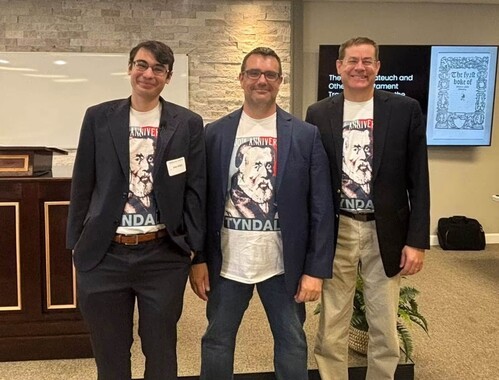
United by a shared interest in God's word and its preservation, Alex Bojko, Bryan Ross, and David Reid bring complementary perspectives to the study of Bible history, translation, and the development of the English Bible. Through historical research, biblical teaching, and thoughtful examination of the evidence, they seek to help others better understand the remarkable history of the Scriptures and the individuals whose labors helped bring God's word to the English-speaking world.
Alex Bojko brings a thoughtful, historically grounded approach to the study of the Bible and its transmission through the centuries. His presentations explore the life and times of William Tyndale, the development of early English Bible translations, and the theological convictions that shaped the work of the Reformers. Through careful historical examination, Alex helps audiences better understand the people, events, and circumstances that contributed to making the Scriptures available in the English language.
Bryan Ross is a dedicated student and teacher of Bible history, with a particular emphasis on the preservation of Scripture, the history of the English Bible, and the King James Bible. His teaching combines historical research with detailed analysis of translation methods, textual development, and the English language. Through his presentations, Bryan seeks to equip believers with a deeper understanding of how God's word has been transmitted, translated, and preserved for English-speaking readers.
David Reid brings an analytical and engaging approach to the study of Scripture and church history. His presentations examine significant events and individuals in the history of the English Bible, including William Tyndale's early translation efforts, his enduring legacy, and the historical context surrounding his work. David encourages audiences to examine historical claims carefully, distinguish fact from tradition, and develop a more informed appreciation for the history of God's word.